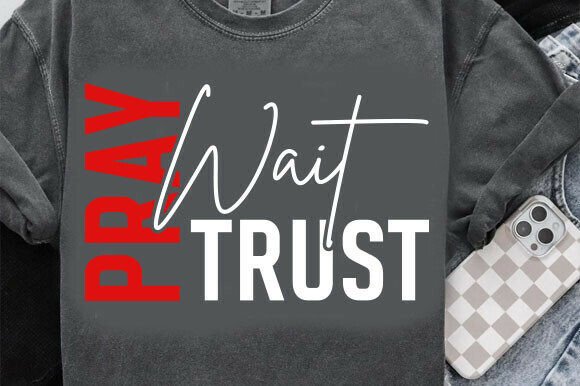
Pray Wait Trust Christian SVG
A Quiet Anchor for Thoughtful Embroidery Projects
As someone who’s stitched thousands of designs across apparel, home goods, and personalized gifts, I opened Pray Wait Trust Christian SVG expecting simplicity—and found something more: a gentle, centered rhythm in its composition. It’s not flashy or ornate. No florals, no halos, no elaborate borders. Just clean, confident lettering with subtle spacing and soft curve modulation—especially in the “a” and “g”—that reads as both reverent and approachable. That matters deeply when you’re translating faith-based sentiment into tangible, wearable meaning.
First Impressions: Mood Over Markup
The design breathes calm. Not passive stillness, but active patience—the kind you’d want on a newborn’s onesie, a nurse’s scrub top, or a counselor’s tote bag. Its vertical alignment and modest height (likely under 3.5 inches tall at standard scaling) make it inherently versatile for center-chest placement, pocket accents, or lower-hem embroidery. It doesn’t shout; it settles. That makes it ideal for T-Shirt Designs aimed at quiet confidence—not trend-chasing—but also unexpectedly strong on textured surfaces like canvas totes or terry cloth towels where busier motifs would compete with grain or loop.
Where It Shines—And Where It Asks for Care
I tested Pray Wait Trust Christian SVG as the focal point on a midweight cotton-blend sweatshirt—a real-world staple for church volunteers, small-group leaders, and boutique gift shops. Stitched with 40-weight poly thread and medium-cutaway stabilizer, the letters held crisp edges without stiffness. The satin stitch outlines gave just enough sheen to lift the phrase without glare; the fill stitches remained even and breathable. No puckering. No skipped stitches—even across the slight curve of the shoulder seam.
It also translated beautifully onto a linen-cotton tea towel: soft contrast, legible at arm’s length, and wash-stable after three cycles. For baby embroidery? Yes—but only on stable, pre-shrunk cotton interlock or double gauze. Avoid ribbed knits or ultra-thin jersey unless you add tear-away + topping and reduce density slightly. On dark fabric, stick with cream, heather gray, or navy thread—not white—unless you’re willing to add a backing layer for opacity.
Watch These Spots Closely
- Caps and curved surfaces: The straight-line flow works best on flat or gently contoured areas. Skip the crown curve unless you’re using a cap frame and have confirmed the file’s stitch path accommodates distortion.
- Small hoop sizes: If your smallest hoop is under 4x4”, test scaling first. Tight kerning between “Wait” and “Trust” could compress detail at sub-3” heights.
- Layered garments: Avoid placing it directly over seams or pockets unless you’ve stabilized both layers—especially on hoodies with kangaroo pockets underneath.
- Frequent-wash items: While the stitch density feels moderate, always use high-quality thread and secure jump stitches. Don’t rely on running stitch alone for outlining—it needs satin or stem stitch definition for longevity.
More Than a Phrase—A Brand Alignment Tool
For Etsy sellers and small shop owners, Pray Wait Trust Christian SVG isn’t just another machine embroidery design—it’s a subtle brand amplifier. When paired with neutral palettes and natural fibers, it signals intentionality. Customers notice that. A customer buying a linen pillow cover with this phrase embroidered in oatmeal thread isn’t just purchasing decor—they’re investing in a mood, a value, a pause. That elevates perceived handmade product value far beyond the stitch count.
It also performs well in digital contexts: clean in printable mockups, legible in black-and-white line art previews, and adaptable across seasonal listings—equally resonant for Easter, Mother’s Day, or quiet everyday gifting. For craft fairs, pair it with minimalist packaging and handwritten tags. No extra explanation needed. The phrase carries its own weight.
Design Notes You’ll Actually Use
- Always test on scrap fabric first—especially if stitching on textured weaves or blends. Linen, terry, and brushed cotton behave differently than plain-weave poplin.
- Check thread color contrast before committing to a full run. What reads softly on ivory may disappear on ecru. Print a grayscale mockup to verify legibility.
- Review stitch density in your embroidery software. If fill areas look overly dense or sparse, adjust underlay or stitch angle—not just size.
- Confirm hoop size compatibility before digitizing or purchasing. Some versions may be optimized for 5x7”, others for 4x4”. Know your workflow.
- Inspect corners and curves at 200% zoom. Tiny hooks or jagged transitions in the “P” or “T” will show up as fraying or unevenness post-stitch.
- Use proper stabilizer: cutaway for knits, tear-away for wovens, and fusible + topping for nap-heavy fabrics like fleece.
- Verify licensing before selling finished items or bundling the file digitally. Commercial use rights aren’t automatic—even for faith-based designs.
Final Thought: A Design That Earns Its Space
Pray Wait Trust Christian SVG won’t dominate a busy market stall—but it will hold attention in the right context. It belongs on garments meant to be worn slowly, gifted meaningfully, and kept long. Whether you’re embroidering a custom apron for a new kitchen ministry, a set of nursery pillows, or a limited-run collection for a local boutique, this design earns its place by doing one thing exceptionally well: inviting pause without demanding attention. That’s rare. And for designers, makers, and small business owners who build with care—not volume—it’s exactly the kind of embroidery file worth keeping on speed dial.