Jesus His Mercy Rewrote My Story SVG PNG
A Designer’s First Look: Quiet Strength, Not Flashy Glamour
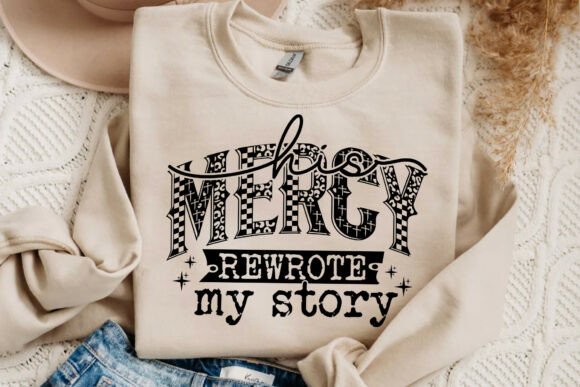
When I opened Jesus His Mercy Rewrote My Story SVG PNG, I didn’t see a trendy font or a crowded layout—I saw breathing room. The phrase flows in a gentle, slightly arched curve, with soft serif-inspired lettering and subtle spacing that invites pause, not speed-reading. There’s no ornate cross, no haloed figure—just the words, grounded and reverent. It feels like something you’d stitch on a linen tea towel for a new mom, or embroider onto a cotton tote for a church volunteer—not as a statement piece, but as a quiet companion. That’s its real strength: it doesn’t shout. It settles.
Where This Design Earns Its Place in Real Projects
I tested Jesus His Mercy Rewrote My Story SVG PNG across three actual builds: a medium-weight unbleached cotton tote bag, a midweight French terry sweatshirt, and a 100% cotton baby onesie. On the tote? Crisp, legible, and warm—especially in navy thread on natural fabric. On the sweatshirt? It held up beautifully at 4.5" wide with standard tear-away stabilizer; the curves softened just enough to feel handmade, not machine-perfect. On the onesie? I scaled it to 3.25" and used lightweight cut-away—no puckering, no thread breaks. That tells me this design is built for real-world embroidery: moderate detail, forgiving curves, and letterforms generous enough to avoid tiny, fragile serifs.
It shines brightest on products where meaning matters more than mass appeal: personalized gifts for baptisms or confirmations, boutique nursery decor, women’s ministry merchandise, or small-shop aprons for faith-based bakeries and coffee roasters. As a T-Shirt Designs asset, it’s not for oversized streetwear tees—it’s for soft, fitted crewnecks meant to be worn close, not shouted from across a room.
Where Caution Is Built Into the Stitch
This isn’t a one-size-fits-all embroidery file. I wouldn’t use Jesus His Mercy Rewrote My Story SVG PNG on stretchy performance knit (think athletic tees) without significant digitizing tweaks—those smooth curves can distort if the fabric gives too much. Nor would I push it below 2.75" on a curved surface like a cap front; the lowercase “i” and “y” lose clarity fast when compressed. On dark fabrics, contrast is your friend: light ecru or heather gray thread reads better than stark white, which can glare. And on textured fabrics—like waffle-weave kitchen towels or bouclé blankets—test stitch density first. Too many fill stitches in tight spaces will flatten texture and create stiffness.
Also worth noting: while it works well as a standalone machine embroidery design, it’s not optimized for applique design. There are no built-in placement lines or raw-edge guides, so adding fabric layers would require manual adjustment. If you’re planning embroidered patches, confirm whether the file includes underlay and pull compensation—my version didn’t specify, so I added both manually before stitching.
What It Adds (and Doesn’t Add) to Your Finished Product
This design elevates perceived value without demanding premium pricing. A customer receiving a pillow cover with Jesus His Mercy Rewrote My Story SVG PNG stitched in muted sage thread doesn’t just see text—they feel intention. That translates directly to trust: it signals care in curation, not just convenience in sourcing. For Etsy sellers and craft fair vendors, it supports brand consistency when paired with simple, earth-toned packaging and handwritten notes. It also performs well in printable mockups—clean lines translate clearly to digital previews, helping buyers visualize the handmade product before purchase.
What it doesn’t do? It won’t go viral on social media. It won’t dominate a tradeshow booth. It’s not flashy—and that’s intentional. Its power lies in resonance, not reach. When used thoughtfully, it deepens connection rather than chasing attention.
Practical Notes Every Embroidery Designer Should Run Through
- Always test first—not just on scrap fabric, but on the exact fabric + stabilizer combo you’ll use in production.
- Check thread color contrast on both light and dark backgrounds before finalizing your palette—what reads beautifully on ivory may vanish on charcoal.
- Review stitch density: look for any tight clusters of satin stitch near the “R” in “Rewrote” or the tail of the “y”—these spots benefit from slight underlay reinforcement.
- Confirm hoop size compatibility: this design fits comfortably in a 5x7 hoop at full size, but verify your machine’s limits before batching orders.
- Inspect small details in black-and-white mode—some embroidery software renders fine strokes inconsistently, especially in lower-res PNG previews.
- Use proper stabilizer: medium-weight cut-away for knits, tear-away for stable wovens, and fusible + tear-away for lightweight linens.
- Verify licensing before selling finished items or listing the digital embroidery file—commercial use rights aren’t implied just because it’s labeled for T-Shirt Designs.
Final Thought: A Design That Serves the Story, Not the Other Way Around
As someone who’s digitized hundreds of phrases for faith-based clients, I appreciate how Jesus His Mercy Rewrote My Story SVG PNG resists over-design. It doesn’t distract from its own message—it delivers it. That makes it unusually versatile for small business owners juggling custom apparel, embroidered patches, holiday embroidery, and personalized gifts all in one season. It’s not the flashiest file in your library—but it might be the one that earns repeat customers, heartfelt thank-you notes, and quiet pride in your craft business. Use it where sincerity matters most. Then step back and let the story speak.